Solar panel laws have become increasingly prevalent in recent years, especially as households seek ways to save money. The shift to sustainable energy has also been a huge driving force. Newer generations tend to be more environmentally conscious, and as new homeowners, they look for communities that allow solar devices.
Are There Solar Panel Laws in Virginia?

Many states have enacted laws on solar energy, and Virginia is one of them. The Virginia Property Owners’ Association Act, the Virginia Condominium Act, and the Virginia Real Estate Cooperative Act all have sections that regulate solar devices.
Homeowners associations, condominiums, and cooperatives are all community associations. These associations are known for enforcing strict rules regarding architectural changes. Solar devices fall under this category.
While solar panels help households save on energy costs, associations dislike them because they can interfere with the community’s aesthetics. Associations aim to maintain a consistent appearance, and solar panels are often viewed as an eyesore. These panels can stick out like a sore thumb, disrupting the community’s uniform look.
With appearance concerns come property value issues, too. Curb appeal can directly impact property value, and solar panels aren’t known for blending in. In communities with shared roofs, there’s also concern that installation might damage the property.
For these reasons, many communities enforce strict rules or even outright ban solar panels. With the move toward sustainability, state legislators everywhere are scrambling to enact laws that control how associations regulate these devices.
Can HOAs Ban Solar Panels in Virginia?
In Virginia, community associations can’t prohibit homeowners from installing solar panels on private property unless the governing documents say otherwise. This regulation is in accordance with solar panel laws under:
- Section 55.1-1820.1 of the Virginia Property Owners’ Association Act,
- Section 55.1-1951.1 of the Virginia Condominium Act, and
- Section 55.1-2133.1 of the Virginia Real Estate Cooperative Act.
Basically, an association can only ban the installation of solar panels on private property if the recorded CC&Rs include such a prohibition. If the CC&Rs are silent, then the board has no authority to impose such a prohibition. Both board members and homeowners should check their governing documents for confirmation.
Can HOAs Ban Solar Panels in Common Areas?
While associations can’t prohibit owners from installing solar panels on their property (unless the CC&Rs say otherwise), different rules apply to common areas. According to solar panel laws in Virginia, associations can prohibit or restrict the installation of solar devices in common areas or elements.
Additionally, an association can impose reasonable restrictions concerning the size, number, location, and placement of solar devices in common areas. These laws apply to HOAs, condominiums, and cooperatives in Virginia.
Are HOA Solar Rules in Virginia Allowed?
In Virginia, associations can enact reasonable restrictions regarding the size, location, and placement of solar panels on private property. According to Section 55.1-1820.1 (for HOAs), Section 55.1-1951.1 (for condos), and Section 55.1-2133.1 (for cooperatives), a restriction is considered unreasonable if:
- The restriction raises the installation cost of the solar device by five percent over the projected cost of the initial proposal, or
- It lowers the solar device’s energy production by 10 percent below the projected output of the initial proposal.
Homeowners may contest an association’s solar panel rules. To do this, they must provide documentation demonstrating that the restriction is unreasonable under the above criteria. An independent solar panel design specialist must prepare this documentation.
Not just any specialist, too. This specialist must have certification from the North American Board of Certified Energy Practitioners. They must also carry a license to practice in Virginia.
Furthermore, Virginia law requires resale certificates to disclose any prohibition or restriction on a homeowner’s right to install or use solar devices on their private property.
Common HOA Restrictions on Solar Panels
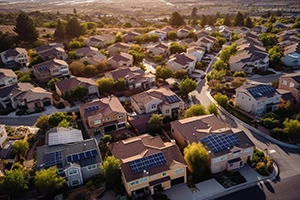
Virginia law allows associations to enforce reasonable restrictions concerning solar panels. While specific rules can vary, common ones require owners to request approval, meet design and placement requirements, adhere to installation standards, and ensure upkeep.
1. Request for Approval
Most associations require homeowners to obtain architectural approval before installing solar panels. This process ensures that the owner’s proposal meets the association’s aesthetic, safety, and placement requirements.
While the process can vary, it typically involves completing a detailed form and submitting supporting documentation. These can include design plans, color schemes, and contractor information.
If an owner fails to secure approval before installation, the association may order its reversal. The owner must obtain approval through the architectural review process and then proceed to install the solar panels after receiving the green light—all at the owner’s expense, of course.
2. Design Requirements
Since appearance is a common concern, associations may require panels to match the home’s roofline. They may also have rules regarding the color scheme and must avoid highly reflective materials. Some even stipulate that panels should blend into the roof as much as possible.
3. Placement Restrictions
Many associations require installing panels in specific locations, such as the roof or the back of the house. This minimizes the panels’ visual impact and helps ensure they aren’t visible from street level.
That said, associations must be careful when enforcing such a restriction, as it may be considered unreasonable under Virginia law. If placing the device at the rear of the house reduces energy production by 10 percent, then a homeowner can challenge the rule.
4. Installation Standards
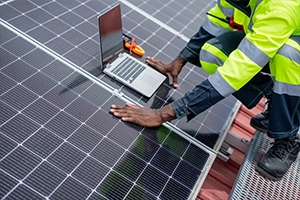
More often than not, associations require owners to hire a licensed professional to install the panels. Additionally, they must adhere to all local building codes and safety regulations. Boards may also request proof of permits, licenses, and insurance.
5. Maintenance Requirement
If homeowners wish to install solar panels on their private property, they must also ensure maintenance. Associations typically require owners to maintain the devices, ensuring they remain in good working order. If there’s any roof damage, homeowners must repair it.
The Commitment Toward Sustainable Energy
There is a growing movement to shift to the use of renewable energy. As climate change and depleted resources raise concerns, more households are investing in solar devices.
Contrary to what some may believe, going solar for HOAs can have benefits. Solar power can reduce energy costs for both homeowners and the association itself. It’s a clean source of electricity, too, so associations that wish to reduce their carbon footprint should invest.
In areas with net metering policies, the HOA can also sell excess electricity generated back to the grid for credits or payments. Some cities or states even offer tax incentives and rebates to encourage the move.
There’s a common concern that solar panels can lower curb appeal and property values, but the opposite can also be true. More and more people are looking for ways to save costs and lead more sustainable lives. Communities that not only allow but also openly embrace solar energy tend to be more attractive to these types of buyers.
A Better Tomorrow
Associations that restrict solar energy must ensure their rules align with solar panel laws in Virginia. These laws aim to support household solar devices while helping communities maintain their standards. That said, as solar energy becomes more popular, boards should think twice before imposing total bans.
Keymont Community Management offers expert management services to associations in Virginia, Maryland, and Washington, DC. Call us today at 703.752.8300 or request a proposal to start your journey!
RELATED ARTICLES:
- HOA Reserve Funds: Does It Protect Your Community’s Future?
- Unenforceable HOA Rules In Virginia
- Get Your HOA Finances In Order With Financial Management